What Is Loan Settlement? Complete Guide for Indian Borrowers (2026)
Last Updated: June 2026 | DebtSettleLLP Editorial Team
Let’s be honest if you’ve landed on this page, chances are you’re going through a tough time financially. Maybe your EMIs have become impossible to manage or you’re just trying to understand what options you actually have.
You’re not alone. Thousands of Indians search “What is loan settlement?” every single month some out of desperation, some out of curiosity and some just looking for a way out of a situation that feels overwhelming.
This guide will walk you through everything clearly, honestly, and without the confusing financial jargon.
So, What Exactly Is Loan Settlement?
Simply put, Under rbi Guidelines loan settlement is a process where a borrower and a lender sit down (or communicate) to work out a resolution specifically when the borrower is going through genuine financial hardship and can no longer keep up with regular repayments.
Now here’s something important that a lot of people get wrong loan settlement does NOT mean your loan automatically gets waived off. It’s not a magic fix. Every case is different, and the outcome depends on the lender’s policies, your financial situation, and the regulations in place.
Understanding this from the start will save you a lot of confusion and unrealistic expectations.
Why Do People Start Looking Into Loan Settlement?
Life doesn’t always go according to plan. Here are the most common reasons people find themselves in this situation:
Job Loss — When your income suddenly disappears, even a manageable EMI becomes a mountain. This is probably the single most common reason people explore settlement.
Business Losses — For entrepreneurs and small business owners, a rough patch falling revenue, cash flow problems, unexpected losses can make loan repayments nearly impossible.
Medical Emergencies — A sudden illness or accident doesn’t just affect your health. The bills that follow can completely derail your finances.
Too Many Loans at Once — Juggling a personal loan, credit card dues, and a business loan simultaneously? Over time, that weight adds up.
Salary Cuts — Whether it happened during the pandemic or due to company restructuring, a reduced income can quickly turn a comfortable repayment schedule into a nightmare.
If any of this sounds familiar, you already understand why people start searching for answers.
How Does the Loan Settlement Process Actually Work?
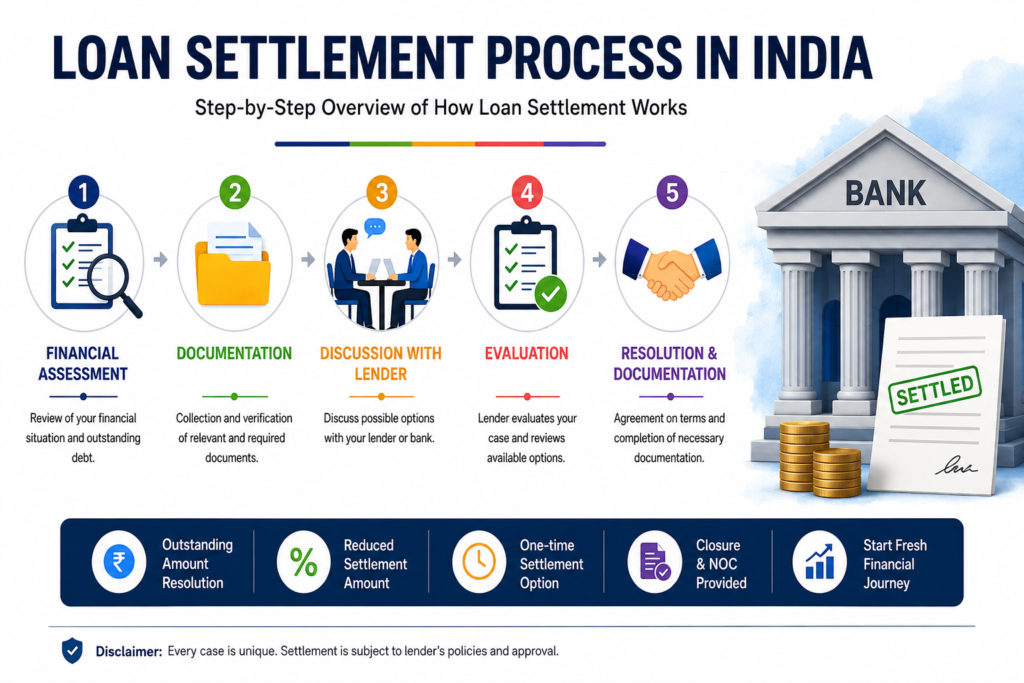
It’s not a one-day thing. Here’s how it generally unfolds:
Step 1 — Your Financial Situation Is Assessed Everything gets reviewed your monthly income, existing liabilities, outstanding debt, essential expenses, and how much you can realistically repay.
Step 2 — Documents Are Gathered You’ll typically need bank statements, salary slips, loan account details, income proof, and sometimes medical documents if a health emergency is involved.
Step 3 — Communication With the Lender Either you or an authorized representative reaches out to the lender to discuss what options are available.
Step 4 — The Lender Evaluates The lender reviews your full situation and decides what, if anything, can be offered.
Step 5 — Resolution and Documentation If an agreement is reached, the lender issues the relevant paperwork based on their internal process.
Going into this process informed rather than panicked makes a significant difference.
Which Types of Loans Are We Talking About?
Personal Loan Settlement
Personal loans are unsecured meaning there’s no property or asset backing them. That makes them one of the most common debt types people discuss settlement for. Lenders typically look at your outstanding balance, employment status, income, repayment history, and proof of hardship.
Credit Card Settlement
Credit card interest rates are brutal. Once the balance starts growing, it can feel like you’re running on a treadmill that keeps speeding up. Borrowers in this situation often look for structured ways to resolve the debt.
Unsecured Business Loan Settlement
These cases tend to be more complex. It’s not just your personal income that’s reviewed the financial health of your business matters too.
Loan Settlement vs. Loan Closure They’re Not the Same
This is a really common mix-up. Here’s the difference at a glance:
| Loan Settlement | Loan Closure |
| Happens during financial hardship | Happens after full repayment |
| Depends on lender evaluation | Standard end of any loan |
| Every case is unique | Routine completion |
| May carry different implications | Reflects successful repayment |
In short closure is the normal finish line. Settlement is a resolution reached in difficult circumstances.
What Are the Potential Benefits?
1. Some Financial Breathing Room
Understanding that options exist can itself bring relief during a stressful time.
2. Less Anxiety
A lot of financial stress comes from uncertainty. Once you know what’s available, it becomes easier to think clearly.
3. A Path Forward
When the fog lifts, you can actually start planning your financial recovery instead of just surviving day to day.
4. Professional Guidance Helps
Having someone experienced on your side means you’re less likely to make costly mistakes during the process.
But There Are Real Risks Too — Know Them
Please don’t jump into this without understanding the downsides:
Your Credit History May Be Affected — Different types of debt resolution impact your credit report differently. This is something you need to understand upfront.
Future Loans Could Be Harder to Get — Lenders look at your repayment history. How a settled account is treated may affect future applications.
It’s Not One-Size-Fits-All — What worked for your colleague or neighbor may not work for your specific situation.
The Lender Has the Final Say — You can’t unilaterally decide to settle. The lender’s approval is non-negotiable.
Go in with realistic expectations. Informed decisions are always better than desperate ones.
Can’t Pay Your EMI Right Now? Here’s What to Do
If you’re in this situation today, early action is everything. Here’s what you should do:
Take stock of your finances — Write down your income, expenses, assets, and liabilities. Get a clear picture before doing anything else.
Don’t take a new loan to pay off old ones — This is a trap that makes everything worse. New debt on top of existing debt is a downward spiral.
Don’t go silent on your lender — Ignoring calls and letters doesn’t make the problem disappear. It usually makes things more complicated.
Get professional guidance — Someone who knows this space can help you understand which options actually apply to your situation.
Mistakes People Commonly Make
Waiting and hoping it resolves itself — It rarely does. The earlier you act, the more options you have.
Using a new loan to pay off old debt — Short-term relief, long-term disaster.
Trusting unverified advice — WhatsApp forwards, random YouTube videos, “guaranteed settlement” promises — be very careful. If it sounds too good to be true, it probably is.
Not understanding the process before signing anything — Read. Ask questions. Understand before you commit.
Dealing With Recovery Calls?
This is a very real and very stressful part of financial difficulties that doesn’t get talked about enough.
If you’re receiving recovery-related calls or pressure:
- Try to stay calm — reacting emotionally can complicate things
- Keep records of every communication
- Know your rights and responsibilities as a borrower
- Reach out for professional help if the pressure becomes overwhelming
You don’t have to navigate this alone.
Settlement Isn’t the Only Option
Before you decide anything, it’s worth knowing what else might be available:
Loan Restructuring — Some lenders are open to modifying loan terms rather than going the settlement route.
Revised EMI Plans — In certain situations, the EMI amount or repayment timeline can be adjusted.
Financial Counselling — A professional can help you see your full picture and identify the best path forward.
Debt Management Planning — A structured strategy to get all your debts under control, step by step.
Settlement might not even be the right answer for you. Exploring all options first is always the smarter move.
Frequently Asked Questions
What is loan settlement in simple terms?
It’s when a borrower who’s genuinely struggling financially discusses a mutually agreed resolution with their lender.
Is loan settlement legal in India?
Yes. It takes place within the framework of lender policies and applicable laws.
Can every loan be settled?
No. Each case is evaluated individually based on the borrower’s circumstances and the lender’s policies.
Can credit card debt be settled?
Borrowers in genuine financial hardship can discuss available options with their lender. Outcomes vary case by case.
Is settlement guaranteed?
No. The lender makes the final call.
Can personal loans be settled?
Each case is assessed individually. There’s no universal answer.
What should I do if I can’t pay my EMI?
Review your finances, stay in communication with your lender, and seek professional guidance as early as possible.
Who should consider professional debt guidance?
Anyone who has significant unsecured debt, is struggling with EMIs, has multiple loans, or simply needs clarity on what options are actually available to them.
Final Thoughts
Financial hardship is stressful there’s no sugarcoating that. But it’s also temporary, and there are ways through it.
Whether you’re dealing with job loss, a business setback, a medical crisis, or just too many loans piling up the first step is always the same: understand your options.
Don’t make decisions out of panic. Don’t trust promises that sound too good. And don’t wait until the situation gets worse.
Informed action, taken early, almost always leads to better outcomes.
About DebtSettleLLP
DebtSettleLLP provides guidance and support for borrowers dealing with unsecured debt challenges, including:
- Personal Loan Guidance
- Credit Card Debt Guidance
- Unsecured Business Loan Guidance
- Recovery Harassment Support
- Legal Notice Guidance
- Debt Resolution Guidance
Need to talk to someone? If you’re struggling with Personal Loans, Credit Card debt, or Unsecured Business Loan obligations and want to understand your options, reach out to the DebtSettleLLP team for a confidential consultation.
Disclaimer: DebtSettleLLP does not provide loans and does not guarantee any settlement outcomes. We provide debt resolution and settlement guidance services. Every case is unique, and outcomes depend on individual circumstances, lender policies, and applicable regulations.